

Picture your best shift supervisor. Knows the floor cold. Troubleshot problems before they get reported. The crew trusts him. You promoted him two years ago. Every morning, he’s still out there pulling product, adjusting schedules by hand, and filling in for whoever called out. He’s doing the job he used to do, plus the job he was promoted into. He’s buried, and so is the team waiting on decisions only he can make. That’s leadership overload. And in manufacturing, it’s one of the most common and least examined problems in the building.
Why It Happens
Most managers don’t stay in the weeds because they’re bad at their job. They stay there because they’re good at it. The hands-on work is familiar. The results are visible. The feedback is immediate. Leadership, by contrast, is slower, murkier, and harder to measure. There’s also the pull from above. When production pressure is high, owners and executives often go back to the person who has always delivered. That person is usually the newly promoted manager who hasn’t fully stepped into the leadership role yet. Every time that happens, it reinforces the wrong pattern.
Add to this the reality that most manufacturing companies don’t have a formal process for developing managers. Promotion tends to happen because someone was technically excellent, not because they were ready to lead. Then the expectation is set: keep performing like before, just with a new title. The result is a person caught between two roles, not fully executing either one.
The business feels this in specific ways. Decision cycles slow down. Problems that should be caught by a team leader end up on the plant manager’s desk. Middle managers lose credibility with their crews because they’re not actually managing. And the people below them don’t grow because someone above them is always handling things before they get the chance.
What Leadership Overload Actually Costs
The costs don’t show up on a single line item. They show up in the aggregate.
Throughput suffers when supervisors are filling operator roles. Turnover increases when capable people don’t see a path forward. Quality problems slip through when the person responsible for oversight is too deep in the work to catch patterns. Customer relationships erode when the plant manager can’t return a call because they’re on the floor solving something their team should have handled.
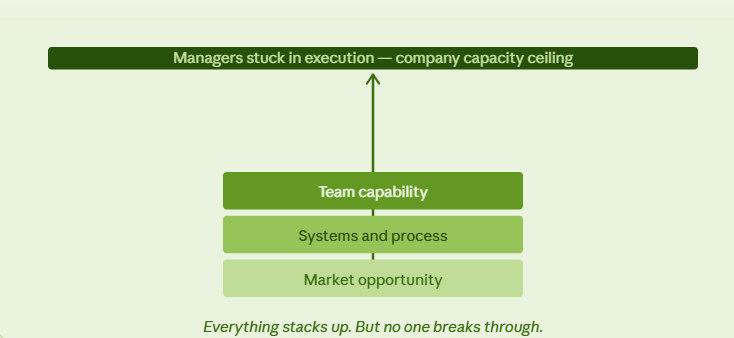
There’s a ceiling effect too. A company grows to the capacity of its leadership layer. If that layer is spending 70 percent of its time on execution, the business has effectively capped its own potential. The owner or CEO can push growth from the top, but without a functioning middle layer, there’s no machine to drive it forward.
If you’ve noticed that your org chart has gotten longer without actually becoming more capable, this is worth examining. The signs you have outgrown your org chart are often rooted here, in a group of managers who were promoted but never fully transitioned out of the work. A related read on that: 7 Clear Signs You Have Outgrown Your Org Chart (And What to Do About It).
The Transition Most Managers Never Get
When someone moves from operator to supervisor, or from supervisor to plant manager, the expectation in most operations is that they’ll figure it out. Some do. Many don’t. The job changes fundamentally. Success is no longer about what you personally produce. It’s about what your team produces. That shift is harder than it sounds, especially for people who built their reputation on personal output.
The transition requires a different set of skills: running structured team communication, holding people accountable without doing the work for them, and identifying problems through observation rather than by getting involved in solving everyone’s. These aren’t instincts. They’re learned behaviors, and they take time and a deliberate effort to develop.
Most manufacturing companies skip this step. The new manager is expected to absorb the role by proximity. If it doesn’t work, the assumption is that the person wasn’t right for the job. But more often, the person was right for the job and was never given the tools to do it.
This is one of the core arguments for investing in your leadership team before you need them to perform at a higher level. Building a leadership team that makes confident decisions without you is the actual goal, and it doesn’t happen by accident.
A Framework for Pulling Managers Out of the Weeds
The fix doesn’t have to be dramatic, just methodical.
Start by getting honest about how your managers are actually spending their time. Most owners who go through this exercise are surprised. A plant manager logging twelve-hour days is often spending half of those hours on work that belongs to someone two levels below them. That’s not a discipline problem. It’s a structure problem.
Once you have a clear picture of where time is going, you can start to reassign work intentionally. This doesn’t mean dropping tasks without support. It means identifying who should own what, creating visibility around those decisions, and holding the handoff. Structured accountability is the other piece. Managers who are used to doing the work themselves often struggle to hold others accountable for it. That’s a coaching conversation, not a performance issue. The goal is to help them see that their value is in the outcomes their team delivers, not in the effort they put in directly.
Regular one-on-one conversations between the manager and their team members create the communication rhythm that makes delegation sustainable. When a supervisor knows what’s happening with their people on a weekly basis, they’re less likely to feel like they need to be everywhere at once. Finally, protect the space. If an owner or executive keeps pulling managers back into execution when pressure spikes, the development effort collapses. The behavior at the top has to match the goal of building a capable middle.
For companies wrestling with how to structure this work more broadly, the principles behind founder-led organizational growth apply directly: the bottleneck is usually in the layer closest to the work, and the fix requires a structural change, not just a mindset shift.
When Good Managers Stay Stuck
There are situations where a manager genuinely doesn’t want to move up. Some people are exceptional at the supervisory level and have no interest in stepping into a broader leadership role. That’s not a failure. But it needs to be acknowledged clearly, because it affects how you staff around them. More often, the people who appear stuck actually want to grow. They’re waiting for clarity. They don’t know what’s expected of them at the next level. They haven’t been told what success looks like in a leadership role versus a technical one. In those cases, a direct conversation about expectations and a concrete development path go a long way.
The companies that get this right tend to have a shared language around what leadership actually means inside their operation. It’s not about title or tenure. It’s about where your attention goes and what you’re accountable for.
The Payoff
When managers step fully into leadership roles, the business can grow in ways it couldn’t before. Owners get time back. The middle layer starts catching problems instead of creating them. Decisions get made closer to where the work happens, which is faster and usually better.
It also changes what you can ask of your organization. An operator can follow instructions. A supervisor can manage a shift. A real leader can build a team, develop people below them, and improve the system they’re responsible for. That’s a different kind of capacity, and it’s the kind that compounds.
Getting there requires something most manufacturing companies don’t budget for: intentional leadership development. Not a seminar. Not a checklist. A real commitment to defining what leadership looks like at each level and investing in the people who are ready to grow into it.
The talent is usually already in your building. Leadership overload isn’t a people problem. It’s a development problem. And that’s one you can solve.